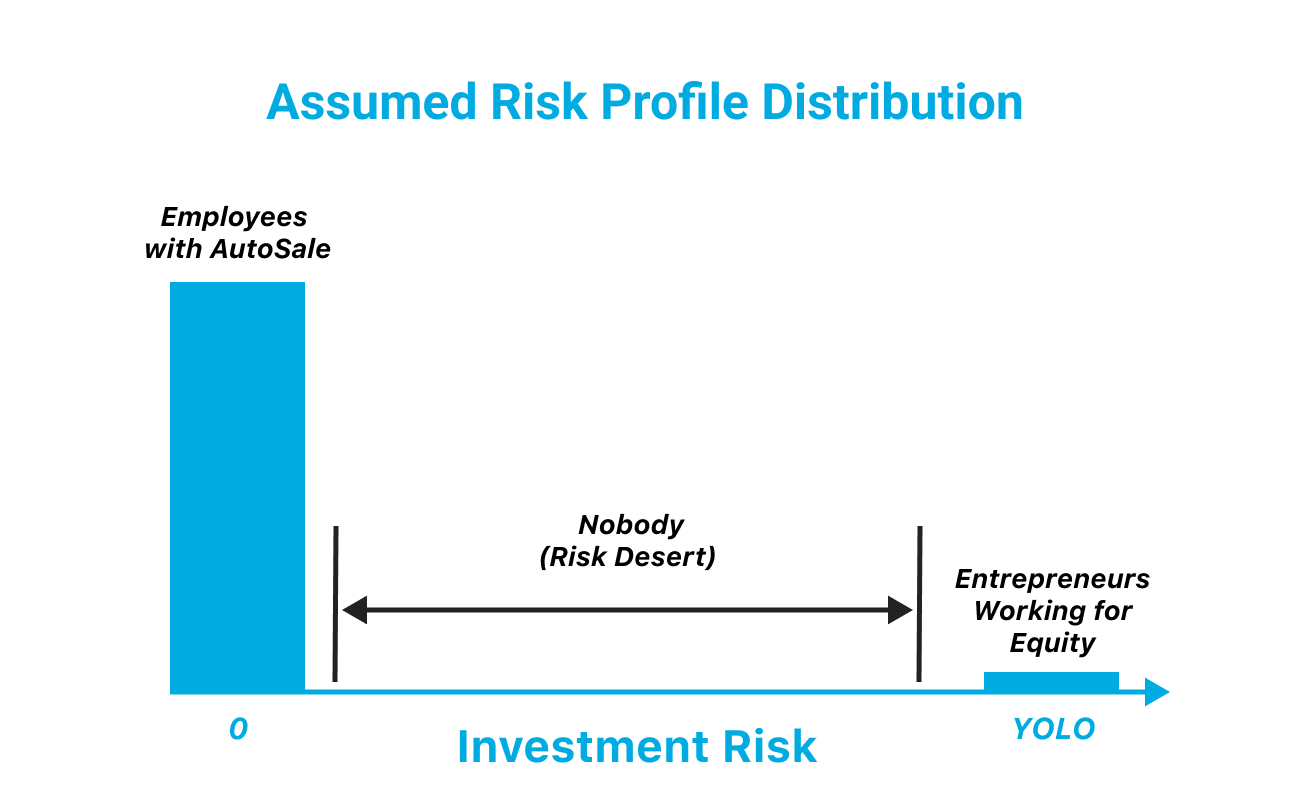
A common mistake in financial planning is telling that everyone should enroll in RSU auto-sale. People giving that advice implicitly assume that everyone else has the same low risk tolerance as them.
It’s a binary view of the world: on one end, entrepreneurs with sky-high risk tolerance who start companies and work for equity; on the other, everyone else, who supposedly can’t tolerate being invested in their employer and therefore should sell immediately.
Reality isn’t binary. Many people in tech are comfortable taking meaningful risk, even if they’re not founders, and genuinely want to be invested in the companies they work for. What they often lack isn’t risk tolerance, but the tools to understand whether they’re taking the right amount of investment risk.
The real question then becomes: how much exposure is appropriate and how does it fit into the rest of the portfolio?
Would You Buy a MANGOS stock today with cash?
Asking people willing to take more risk “If your RSUs vested today as cash, would you use that cash to buy this stock at today’s price?” is not really helpful because their answer is either “Yes” or “I don’t know.”
It might be straightforward for someone working at a barely growing company, but for employees at Meta, Google or any other MANGOS company who have seen peers build wealth by simply holding their RSUs, the question “Should I buy more META?” is no easier than “Should I sell my current META shares?”
How are these people supposed to make a decision?

Deciding what to do with concentrated, highly appreciated stock can be even harder than deciding what to do with a recently vested grant. A low cost basis, combined with high income and high taxes in states where successful VC-backed tech companies are based, often leads people to choose the easiest option at the moment: doing nothing.
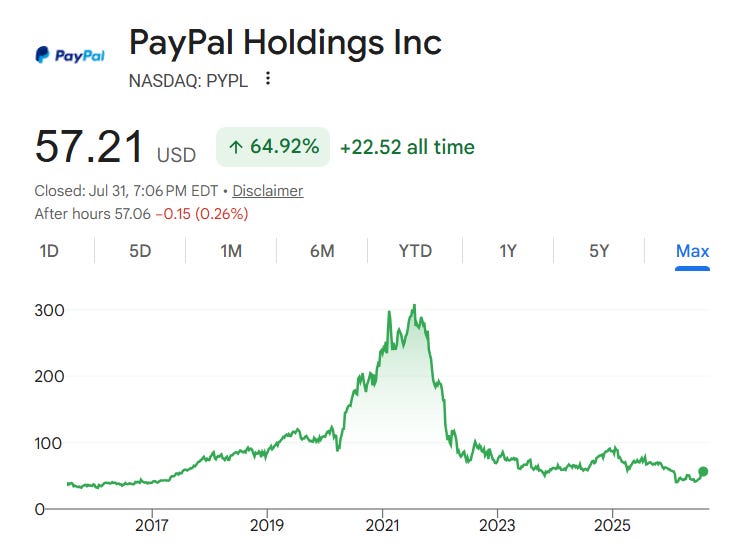
When the market keeps rising and potential risks to future wealth are not fully understood, doing nothing can easily become the default strategy. The problem is that stocks do not always go up. Some of them go down and never recover.
Preparing for such scenarios in a financial plan is crucial for people who want to take risks with their savings. Yes, risks, let’s be honest: when we add individual stocks to a portfolio, we are making a bet.
Rules of Thumb
There are attempts to answer the question, “How much of a single stock can you have in your portfolio?” by offering simple rules of thumb. Recommendations normally range between 1% and 15% of the portfolio and often more reflect personal views and risk tolerance of the person answering the question rather than one asking it.
In reality, the answer to the question is in the range between 0% and 100%. We can demonstrate that by considering a hypothetical and exaggerated example.
Let’s consider a family that has already created a financial plan. They estimate that they need a total portfolio of $5 million to support all their financial goals. Their plan accounts for inflation, taxes, and temporary spikes in spending caused by home renovations, college expenses, medical bills, and travel. It also assumes conservative but steady investment returns.
If the family’s total savings, excluding their primary residence, are $5 million today, they have no room to make bets unless they are willing to sacrifice some of their financial goals. For this family, the appropriate allocation to an individual stock would be 0%.
Now, let’s consider the opposite situation. The family consists of entrepreneurs who built a successful business that is worth $1 billion today, and they still own 10% of it. If the company’s market capitalization cannot fall below $50 million and its stock is liquid, they could theoretically hold 100% of their portfolio in this stock. Even in the worst-case scenario, if their portfolio fell from its current value of $100 million to $5 million, they would still be able to cover all the major future expenses included in their financial plan.
Rules of thumb don’t work because everyone’s situation is different.
How Do You Answer The Question Yourself?
Deciding how much of an individual stock to hold is part of the portfolio construction process. We can’t tell whether a portfolio is well constructed, or whether its allocation to a single stock is reasonable, until we understand the purpose of the money.
That is why we need to create a financial plan first. Once we have a plan, we can evaluate the risks more clearly. Specifically, we can ask what would happen to the family’s financial goals if a particular investment account loses 80% to 90% of its value and never recovers. This is a simple and effective way to assess the risk of holding an individual stock and taking on idiosyncratic risk.
At the end of the day, our priority is to achieve our financial goals. Not to beat the market.

A financial projection that maps major future income and expenses onto a timeline gives you a clearer picture of how your net worth could evolve. As a scenario planning tool, Nauma automates these baseline estimates by factoring in standard inflation, estimated state level taxes, and basic account structures. This gives you an interactive sandbox for testing different choices instead of relying on generalized advice.
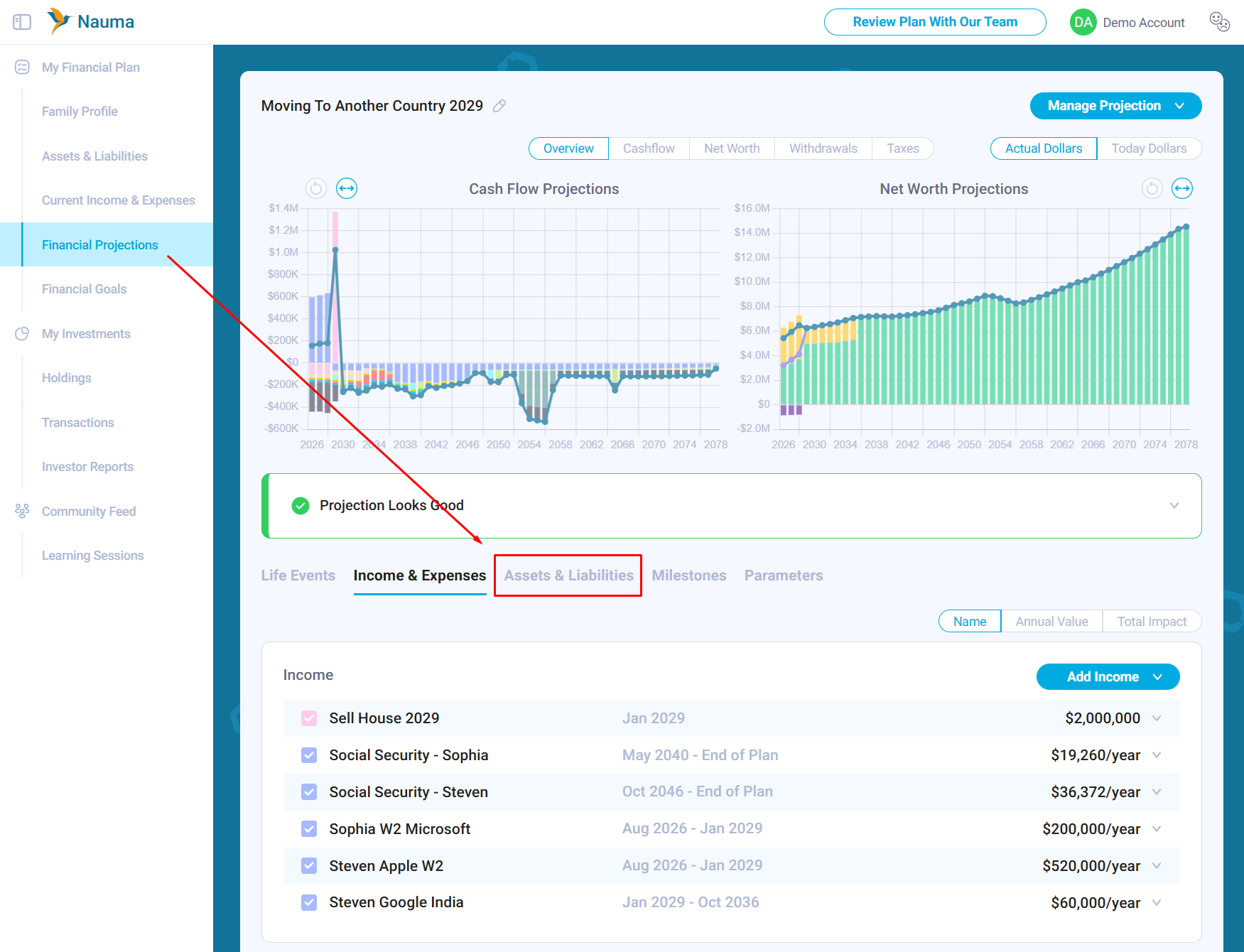
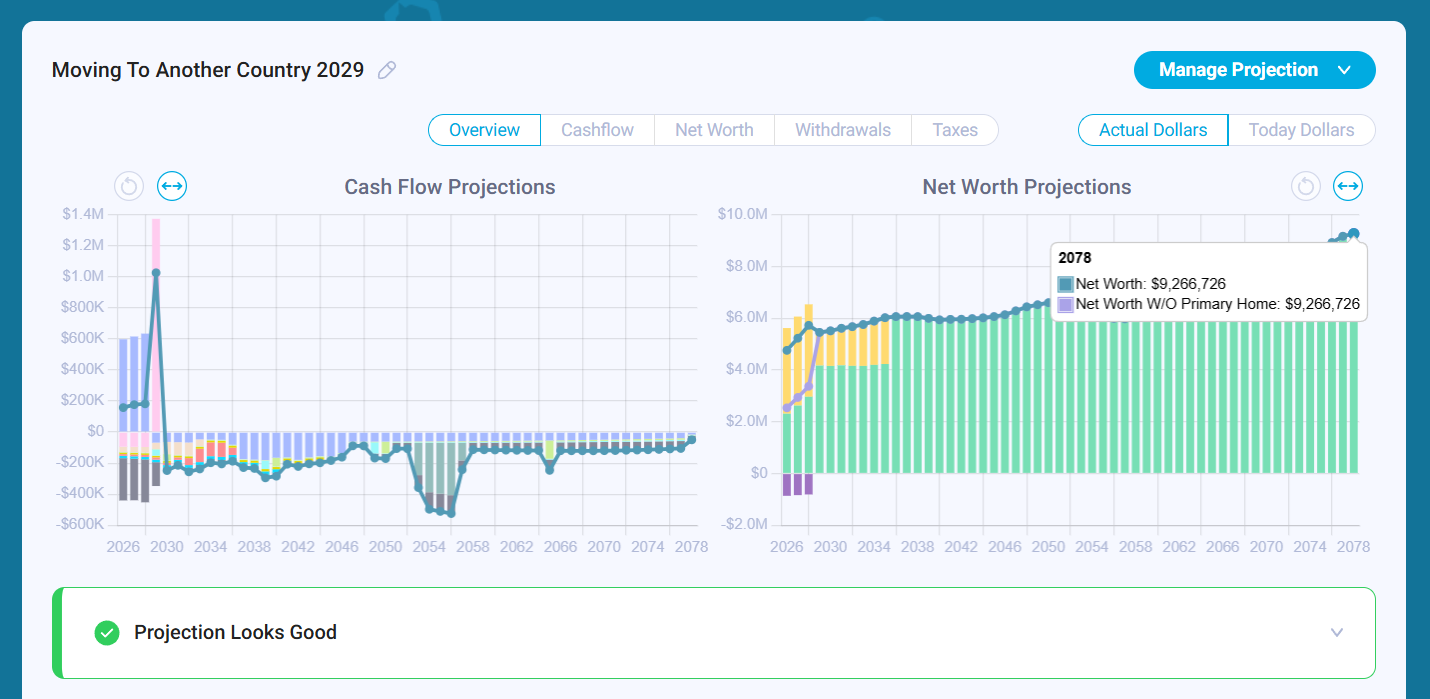
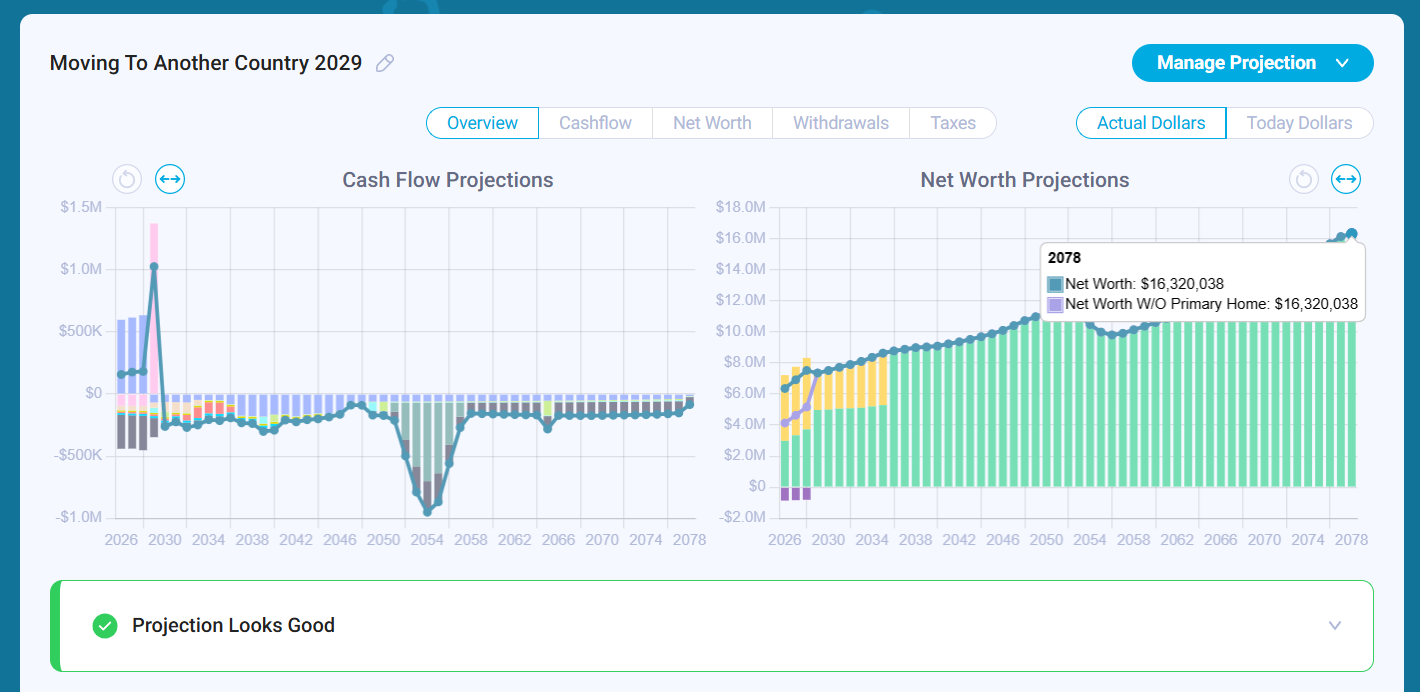
Once you have completed your financial projection, you can go to “Assets & Liabilities” and model different scenarios, including a 90% decline (or any other percentage you consider reasonable) in the value of your stock plan account containing vested RSU shares:
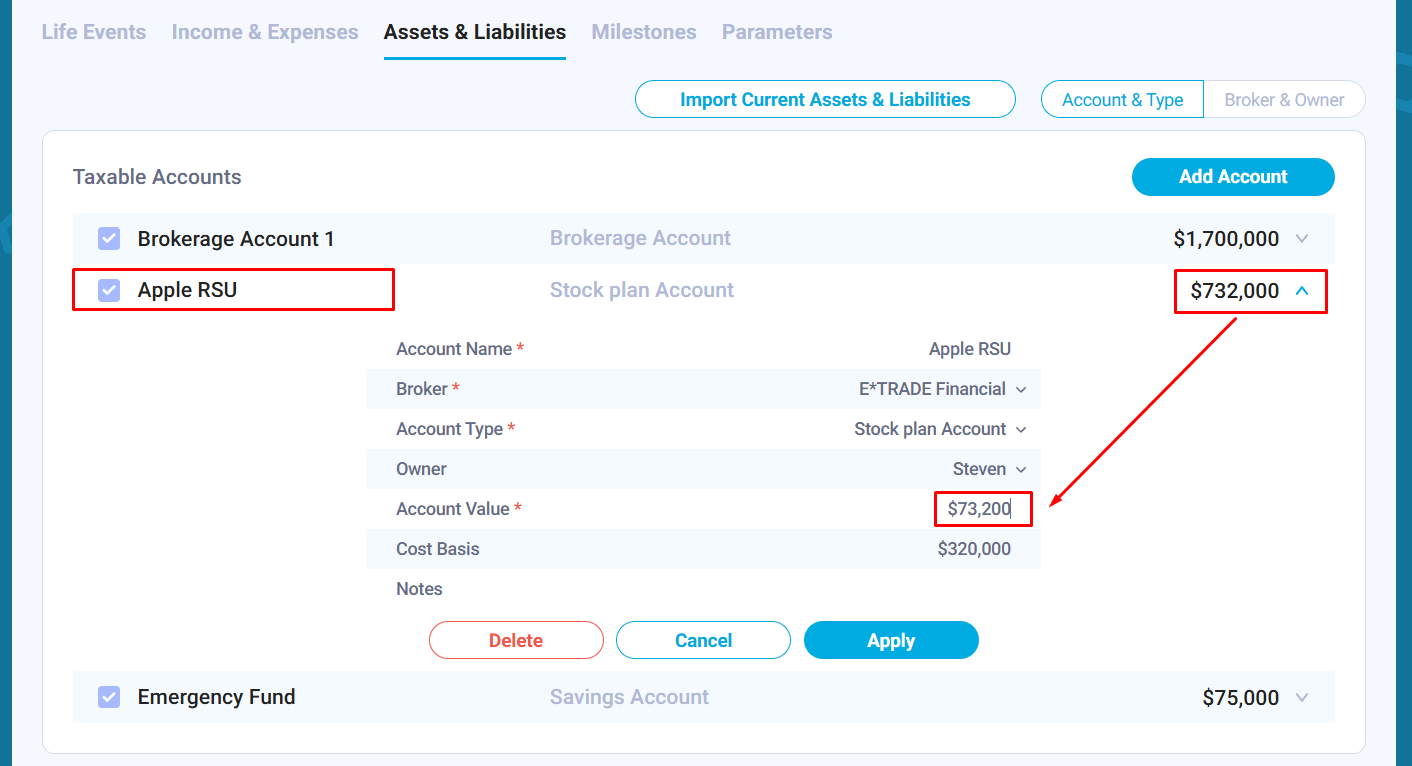
You will be able to see whether your plan still holds after a 90% decline in the value of your RSUs and whether you have the risk capacity to keep an individual stock in your portfolio. When testing different scenarios, keep in mind that it is always wise to use conservative assumptions, even if you strongly believe in the company and its future.
In this hypothetical simulation, the model projects the family ending with a net worth of $9.2 million if their $732,000 RSU position drops 90% today and assuming remaining funds earn baseline market returns. If they diversify immediately, the same mathematical model projects an end state of $16.3 million. While these figures are illustrative projections based on simplified growth assumptions, the model shows the pessimistic outcome and it helps the family understand the risk of holding individual stock better.
In an optimistic scenario, if the company’s stock outperforms the market, the family’s net worth could be much higher than it would be with a diversified portfolio. In general, holding individual stocks makes financial planning more difficult because it widens the range of possible outcomes. In some cases, that uncertainty may be tolerable; in others, it may create a significant risk for the family.
Once you have identified a concentration level you are comfortable with, the next step is to create a plan for diversifying your portfolio if you find that your allocation to a single stock is too high. We will discuss this process and the related tax-planning considerations in future posts.
About The Author
Alex Sukhanov, founder of Nauma, a financial planning platform built for people in tech and high-net-worth families. Alex previously worked at Google and started Nauma to help more people in tech make better financial decisions and achieve more in their lives. You can reach out to Alex on linkedin.
Nauma is supported entirely by its users: no commissions, no affiliate incentives, and no financial products to sell. Built as an independent software platform rather than a traditional advisory firm, Nauma is designed to give tech professionals the tools and modeling clarity to evaluate their own equity, tax, and retirement scenarios.