Financial goals come up in conversations about investing and taxes, but they are rarely specific enough to guide decisions. We often have only a vague idea of what we want to achieve, which makes it difficult to use goals to decide how much to save, how to invest, or how to manage taxes.
Without clear goals, we tend to follow generic advice built around the assumption that more is better: earn more, invest for higher returns, accumulate more wealth.
After working one-on-one with roughly 50 families, building financial models and helping them evaluate major life decisions, I’ve noticed something interesting. Having more money doesn’t necessarily make people feel more financially secure. Someone with a $10M net worth often asks the same question as someone with $1M: “Do I have enough to retire?”
One has 10 times the net worth of the other, but the uncertainty is the same. Why doesn’t having more money answer that question?

The Hidden Cost of Optimizing Without a Target
Chasing more money feels rational, but we rarely question whether the additional money is worth what we’re giving up to get it.
Income: A higher-paying job might require longer hours, more stress, or postponing retirement. Is the additional income worth it if you’ve already saved enough to meet your goals?
Investment returns: A portfolio with higher expected returns usually comes with more risk. If a more conservative portfolio already gives you a high probability of meeting your goals, why take the additional risk?
Saving: Many families continue saving aggressively even when they could afford to spend more today. Without knowing how much they actually need, it’s difficult to decide when to stop accumulating and start enjoying their money.
These decisions are difficult to make without knowing what you’re working toward. Goal-based financial planning starts by defining what you want your money to accomplish, how much it will cost, and when you’ll need it.
Once you’ve translated those goals into numbers, you can evaluate the trade-offs.
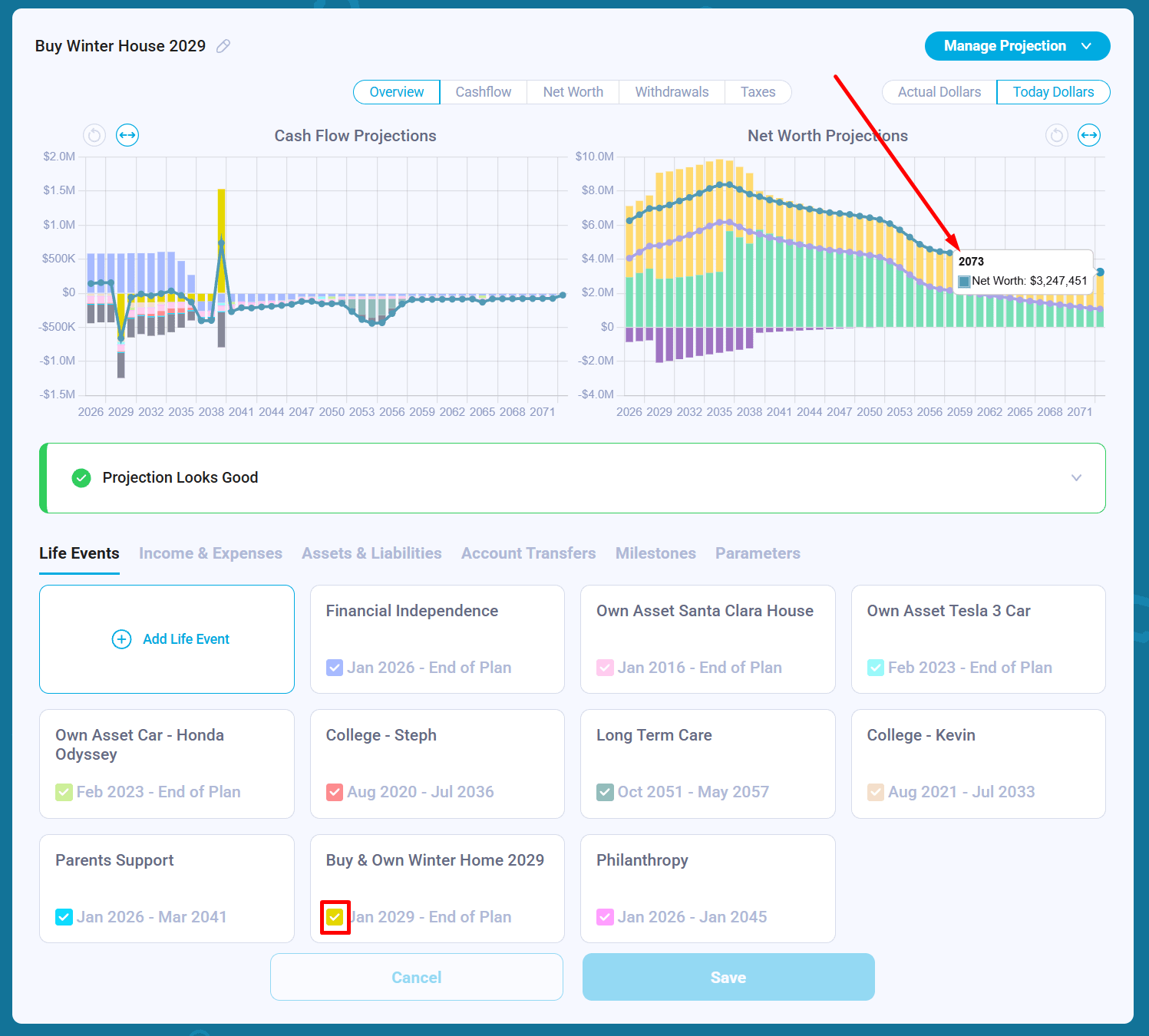
For example, a family’s projected net worth at the end of their financial plan is $4.9M in today’s dollars. If they buy a second home and keep it for 10 years, their projected net worth drops to $3.2M, assuming everything else stays the same.
Now they can put a number on the decision: owning a second home would give them new experiences and memories, but it would also reduce their projected net worth at the end of the plan by $1.7M. With that information, they can decide whether the experience is worth the financial cost.
Financial Planning Is Not About Predicting the Future
I think two misconceptions prevent analytical people from building a financial plan.
They think planning requires predicting the future. Nobody can reliably predict 30 years of market returns, changes in tax laws, or what will happen to their career.
They think a financial plan is something they create once and then have to follow for the rest of their lives. This makes people hesitant to start because they don’t want to commit to decisions they might regret later.
I find it useful to think about financial planning the same way aerospace engineers think about control systems.
When a reusable rocket booster returns to Earth and lands on a floating platform, it navigates wind, ocean waves, varying engine thrust, and shifting fuel weight. Engineers do not land boosters because they predicted every gust of wind in advance. They do it using a feedback loop system with three components: controller, process and sensors.
Financial Planning can work the same way:
Controller (Financial Plan): Uses your current financial situation and goals to determine what adjustments are needed.
Process (Your Actions): You save, spend, invest, and make other changes.
Sensors (Tracking Tools): Measure your actual income, spending, assets, and liabilities so you can compare reality with your projections.

Your initial plan will almost certainly be wrong in some ways. That’s fine. You start with reasonable assumptions, update them as you learn more, and adjust your decisions along the way.
The timing of these adjustments matters a lot.
Consider two families. One has a financial plan and notices early that their retirement savings are falling behind. They have ten years to address the gap, so relatively small changes might be enough. The other family doesn’t have a plan. In their late 50s, a health issue forces them to consider retiring in five years. Only then do they run the numbers and discover they’d need to save 60% of their income to make it work.
The purpose of a financial plan isn’t to tell you exactly what your life will look like in 30 years. It’s to help you recognize when you’re getting off track while you still have enough time to do something about it.
Focus on What You Can Control
Much of the stress in personal finance comes from fixating on variables outside our control. We don’t control market returns, Federal Reserve interest rates, inflation, or future prices. Spending too much time trying to predict them doesn’t help much.
But there are variables we can control or influence:
Income: When to retire, change jobs, take on consulting work, or start collecting Social Security.
Expenses: Reduce spending when necessary, or spend more if our financial plan shows we’re saving more than we need.
Debt: Pay down debt to reduce risk, or borrow when it makes sense for our financial situation.
Investments: We can’t control market returns, but we can decide how much investment risk to take for each financial goal.
Taxes: Choose when to realize capital gains, make Roth conversions, and withdraw from taxable, tax-deferred, and tax-free accounts.
These are the decisions we can revisit as our income, expenses, markets, and personal circumstances change.
What Counts as a Real Financial Goal?
A financial system designed for a specific purpose is easier to manage than one trying to accomplish everything at once. When you treat your entire net worth as a single portfolio, you end up applying the same risk profile and tax strategy to money that you might need next year and money you won’t touch for another 30 years.
Separating your wealth into individual financial goals has two main benefits:
Better risk management. You can take more investment risk with long-term goals while protecting money you’ll need in the near future. You can also set different probability-of-success targets. For example, you might want your baseline retirement spending (Financial Independence) to have a 95% probability of success in Monte Carlo simulations, while accepting more uncertainty for discretionary goals.
More effective tax planning. Some goals can benefit from tax-advantaged accounts, such as 529 plans or retirement accounts. Others require money to be available in taxable accounts.
I think of financial goals as major future expenses. Beating the S&P 500 or earning $X per year isn’t a financial goal by itself. These are investment or income targets, often driven by the assumption that more is better. Once you understand what you actually want to accomplish, you can often find a simpler way to get there without taking as much risk.
You also don’t need a separate goal for every expense. Focus on major commitments, typically in the six-figure range: funding basic retirement living expenses, buying a home, paying for a child’s education, giving money to family, or setting aside $100K–$300K to start a company after leaving a corporate job.
There’s little value in creating a separate financial goal for every $5K expense.
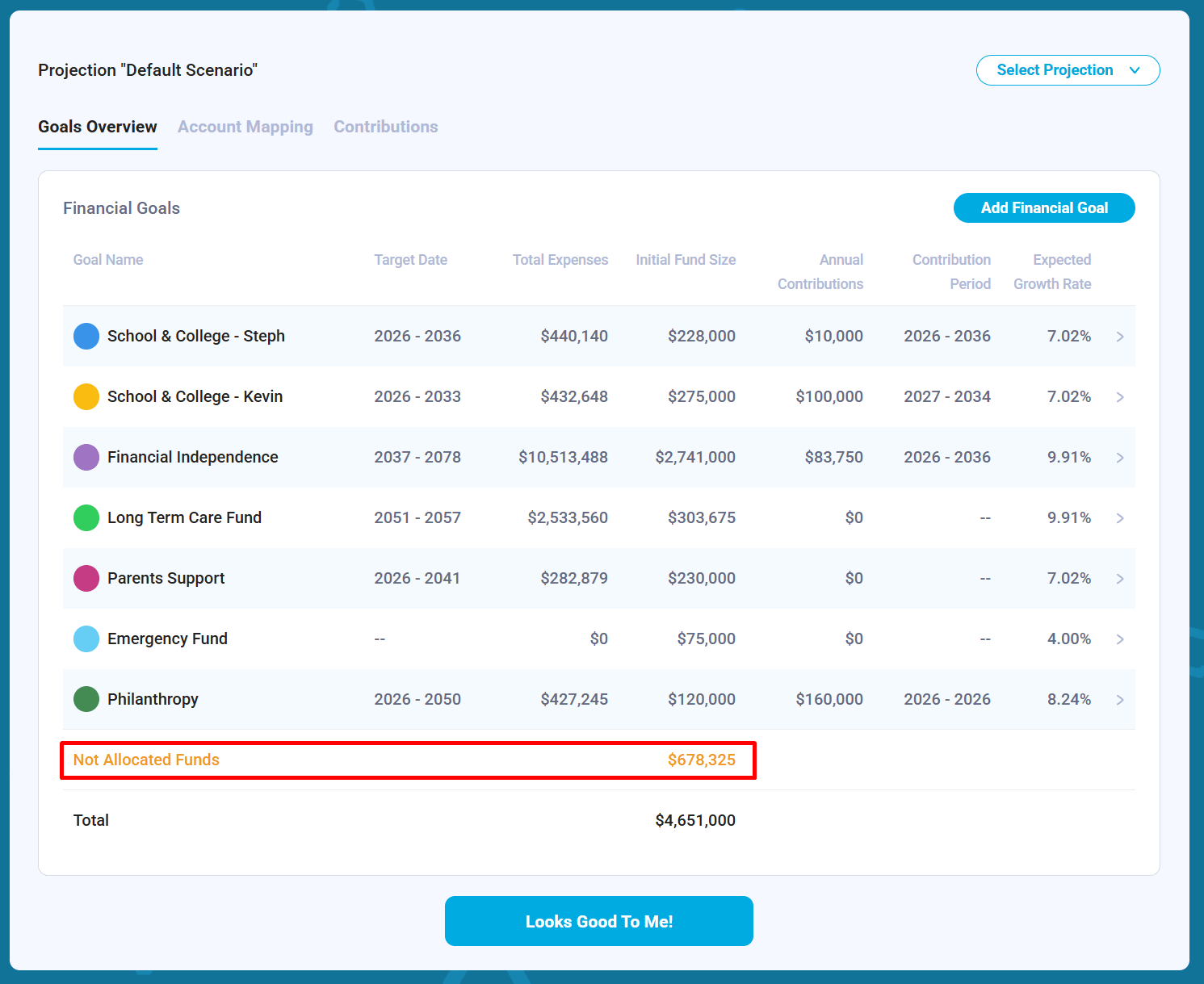
One benefit of funding each financial goal separately is that you can see how much of your net worth isn’t allocated to anything.
Consider a hypothetical household with a $4.6M net worth. They map out their major financial goals, including baseline retirement expenses, housing, and family priorities, and account for future contributions and expected investment returns. After accounting for all these goals, they discover that nearly $678K of their current net worth remains unallocated.
Without this information, many high-income families continue working and saving simply because that’s what they’ve always done. Some reach their 80s or 90s with millions of dollars they never spent, even though they could have retired earlier or made different choices when they were younger.
Identifying $678K in unallocated wealth gives you options: retire earlier, take a sabbatical, start a business, donate more to charity, or help your children financially when the money could make the biggest difference in their lives.
The Five-Step Goal-Based Planning Process
Trying to figure out future expenses, account structure, portfolio allocation, and tax optimization all at once creates too much cognitive load. Separating the process into distinct stages keeps each decision manageable:
Review the current assets, liabilities, income, and living expenses.
Build household-level financial projections: Place expected future cash flows and life events, including college, healthcare, long-term care, Social Security, and career changes, on a timeline.
The model adjusts for inflation, estimates taxes, and projects net worth over time.
This is where families confront real trade-offs: Private school or early retirement? A larger home or more travel? Staying in the Bay Area or relocating?
Structure goals as dedicated funds: Assign an initial allocation, contribution schedule, and investment profile to each goal.
Unlike the “more is better” approach, the target for each goal fund is to gradually reach $0 by the end of its lifetime, covering the expense and associated taxes without overfunding it.
Map goals to accounts: Connect each goal to the specific taxable, tax-deferred, or tax-free accounts that will fund it.
Construct model portfolios and optimize taxes: Only after you know what each account is for can you design the right portfolio and evaluate tax strategies (such as Roth conversions).
Getting Clear on Goals Takes Work
Goal-based financial planning takes effort. Both partners need to sit down and talk about what they actually want. Sometimes they discover they’ve been making different assumptions about when to retire, where to live, or how they want to spend their money. There is no single right answer. Every family has to decide what matters most and what trade-offs they’re willing to make.
Having clear financial goals won’t make the future predictable, but it gives you a way to evaluate your choices and adjust your plans as life changes.
About the Author
Alex Sukhanov is the founder of Nauma, a financial planning platform built for people in tech and high-net-worth families. Alex previously worked at Google and started Nauma to help more people in tech make better financial decisions and achieve more in their lives. You can reach out to Alex on linkedin.
Nauma is supported entirely by its users: no commissions, no affiliate incentives, and no financial products to sell. Built as an independent software platform rather than a traditional advisory firm, Nauma is designed to give tech professionals the tools and modeling clarity to evaluate their own equity, tax, and retirement scenarios.