An early-stage private company announces a tender offer. The company is willing to buy up to 90,000 shares from you as an employee. Price per share is set at $24.50.
You own common stock purchased years ago and also have several vested ISO stock option grants with different strike prices and vested number of options. You have been working for the company for 5 years now, making $150K/year, live in California and file your taxes as Married Filing Jointly.
How would you approach this problem?
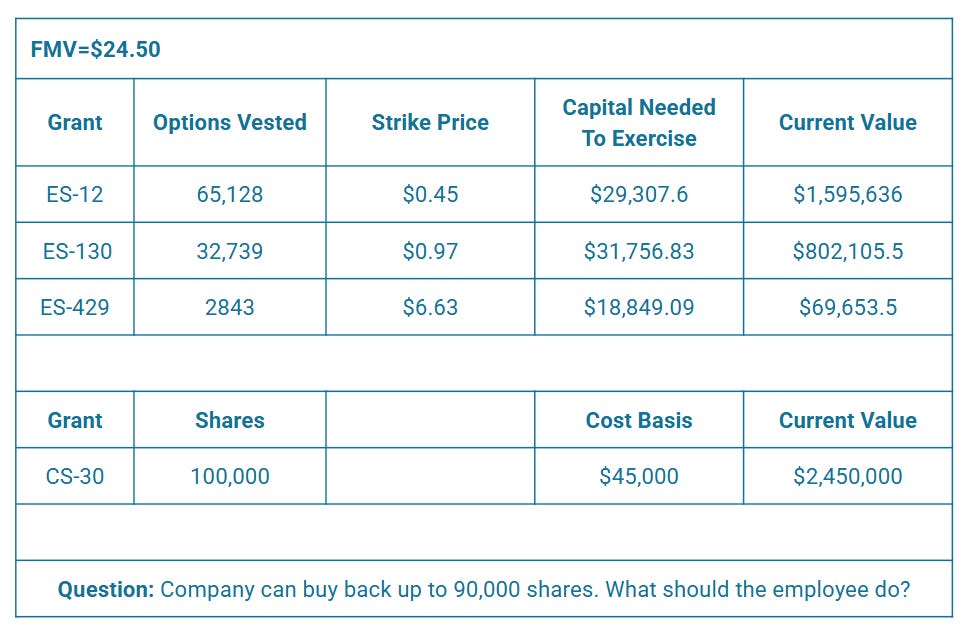
What would you do differently if you knew that your decision could affect this year’s tax bill by $500K and your projected net worth by $1.6M?
Starting With The Right Questions
How many shares the employee is willing to sell is the question the company wants answered. It is tempting to immediately focus on the 90,000-share limit, but better questions to answer first are:
How much money do I need today? Even if the employee believes strongly in the company, they may have financial goals they need to fund: buying a new house, sending their children to a reputable school, or taking care of their parents.
What happens if I do nothing? Unless the employee is leaving the company and has a strict Post-Termination Exercise Period (PTEP) after which the options expire, or they are concerned about the company’s prospects, they may have the option to simply ignore this tender offer.
Keeping the stock options unexercised prevents the family from starting the required 5-year QSBS holding period, but it can also be a safer way to retain exposure to the company’s potential upside without putting additional personal capital at risk.
How many shares of this company do I want to own after the tender offer? That is fundamentally an investment-risk question, and it helps reframe the problem from what the company wants to what the family needs. We previously discussed how an individual can answer such questions in the post “How Much of a Single Stock Can I Have in My Portfolio?“
For instance, if the employee already owns 100,000 shares purchased several years earlier. They could decide to:
reduce their exposure to, say, 50,000 shares,
maintain their existing 100,000-share exposure, or
increase their exposure because they remain highly confident in the company.
Knowing the desired exposure, strike price of the stock option grants and tender offer share price, the family can then plan how to maximize their income while achieving the desired number of shares and managing their risks properly.
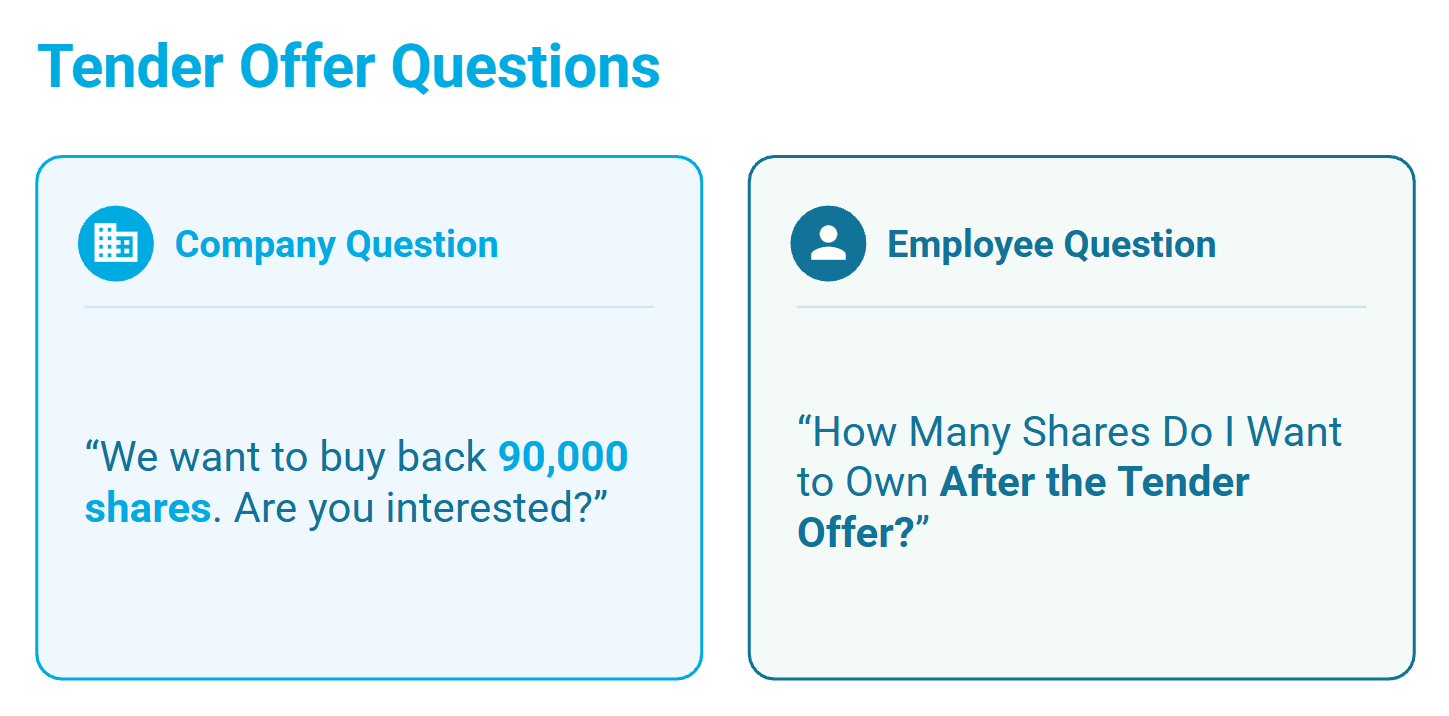
Identifying Options
For this example, assume the family wants to continue owning 100,000 shares after the tender offer, but they are willing to participate in the tender and sell 90,000 shares back to the company to generate liquidity and fund their financial goals. They have a few ways to get there:
Sell their existing shares from the CS-30 grant and then exercise 90,000 stock options to bring their ownership back to 100,000 shares.
Keep their existing shares from the CS-30 grant as is, but exercise and immediately sell shares from their stock option grants (ES-12, ES-130, and ES-429).
What option would you choose?
Option-1: Sell Existing Shares
In the first option, the family sells 90,000 shares they already own from the CS-30 grant.
At the tender offer price of $24.50 per share, the family receives 90,000 × $24.50 = $2,205,000. The cost basis of these shares is $40,500. Because the shares were acquired more than one year ago, the gain is treated as a long-term capital gain. In this example, the shares are not QSBS eligible.
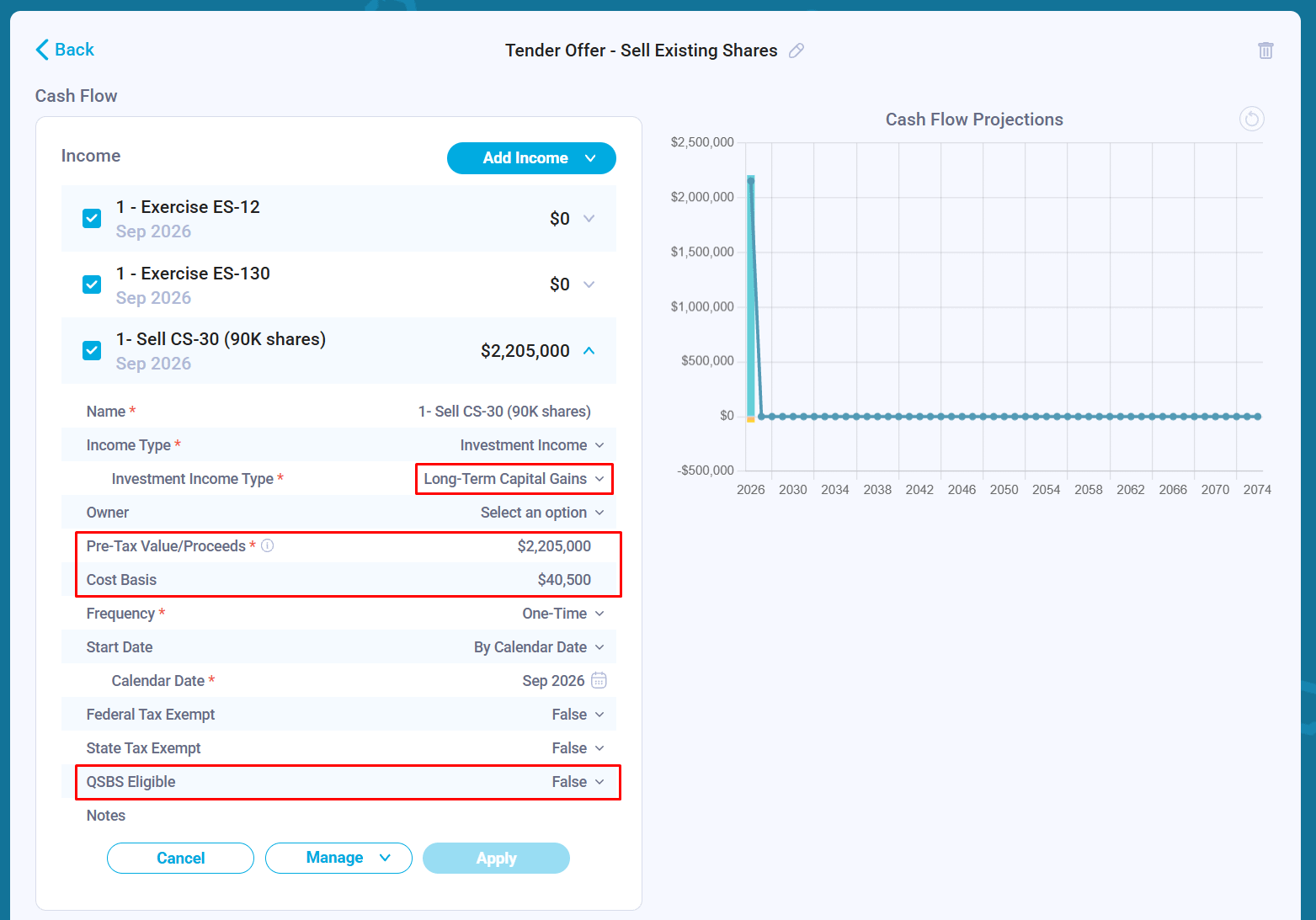
After selling 90,000 existing shares, they therefore exercise 90,000 vested ISO stock options and keep the newly acquired shares. They exercise:
65,128 options from ES-12 at a $0.45 strike price, requiring approximately $29,308
24,872 options from ES-130 at a $0.97 strike price, requiring approximately $24,126
The total capital required to exercise the options is $53,434.
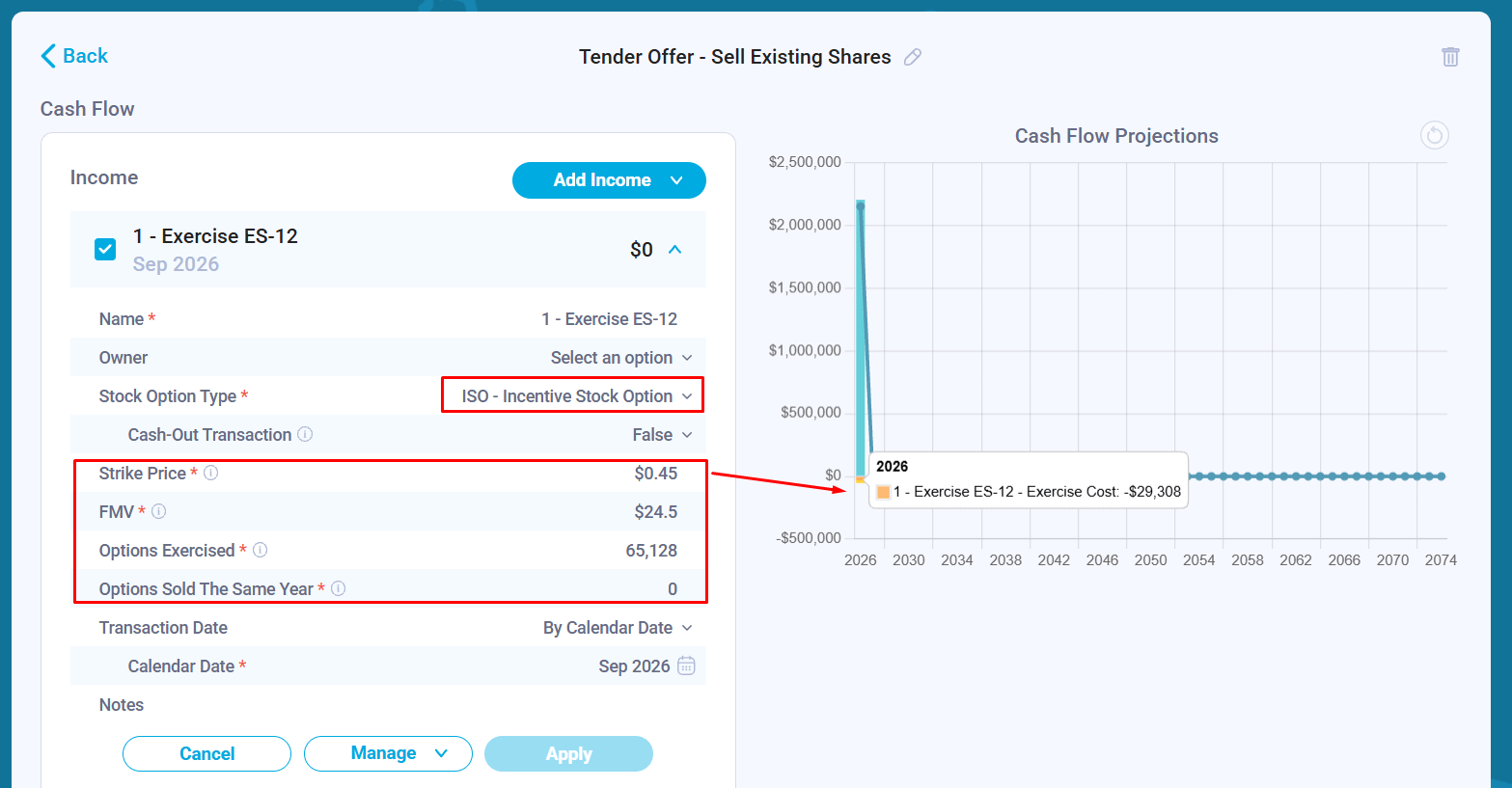
The important part is that the family does not sell these newly exercised ISO shares. That creates a large Alternative Minimum Tax adjustment.
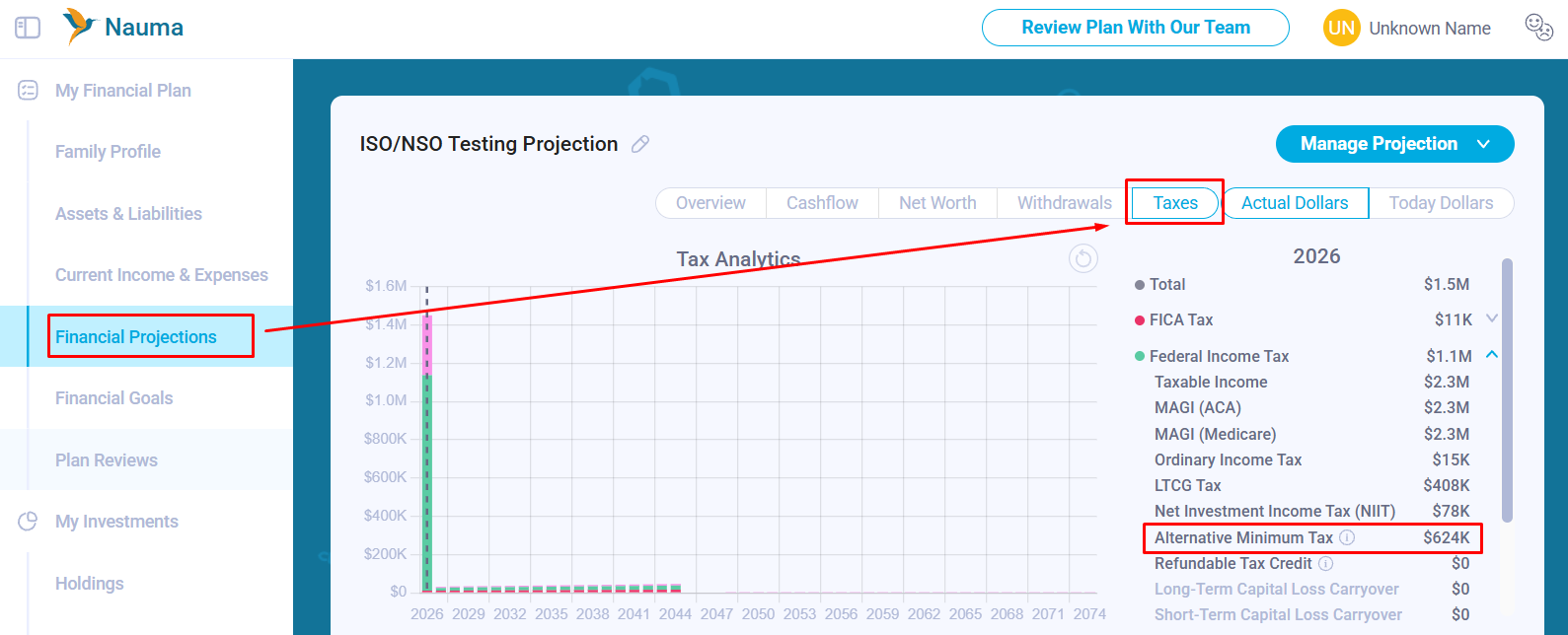
In the projection, the family pays approximately:
$408K in federal long-term capital gains tax
$670K in federal AMT
$78K in Net Investment Income Tax
$67K in California AMT
plus other applicable federal and California taxes
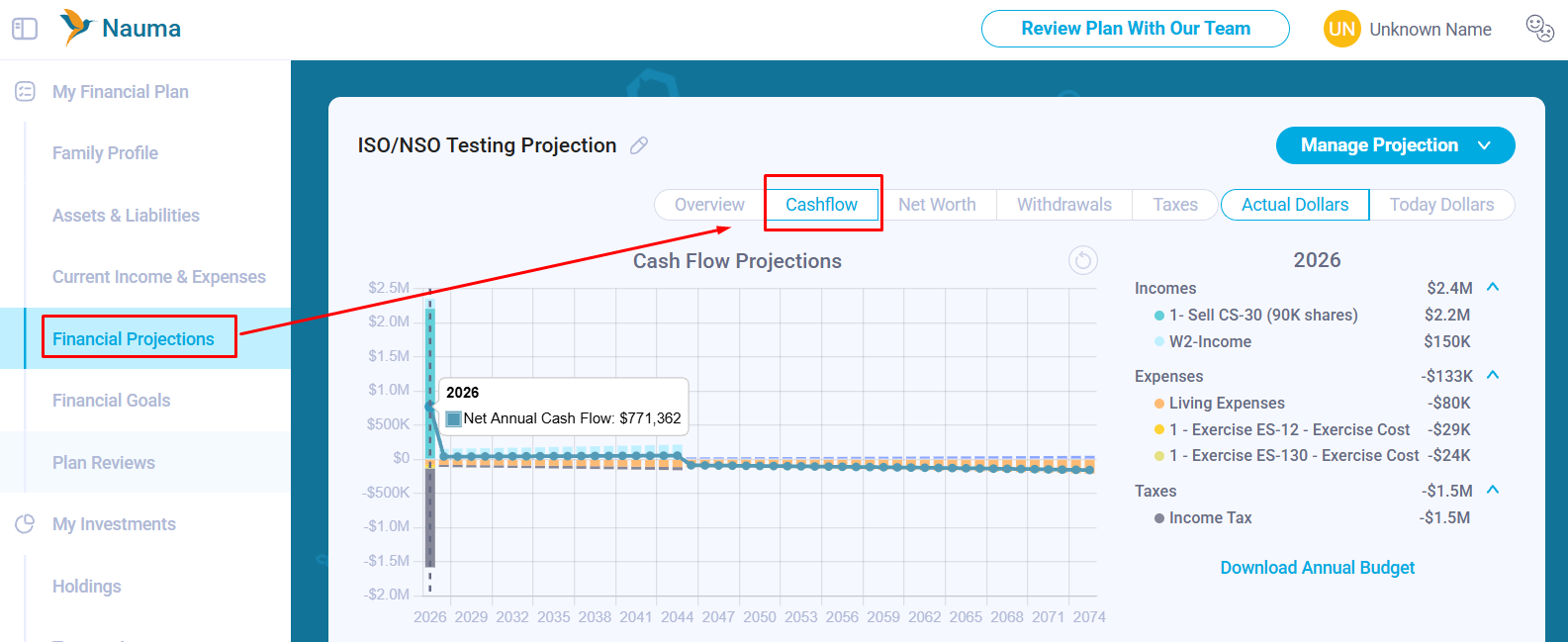
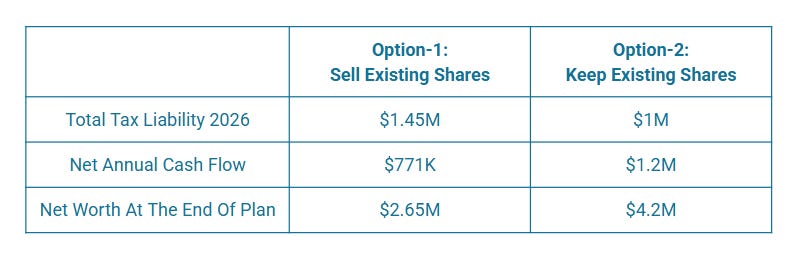
The total estimated tax liability for the year reaches approximately $1.5M. The family’s net annual cash flow is $771K.
Option-2: Keep Existing Shares
Now, instead of selling the existing CS-30 shares, the family keeps all 100,000 of them. They still want to participate in the tender offer and sell 90,000 shares, so they exercise vested ISOs and immediately sell the newly acquired shares back to the company.
The exercise cost is still $53,434, and the shares are still sold for approximately $2.205M.
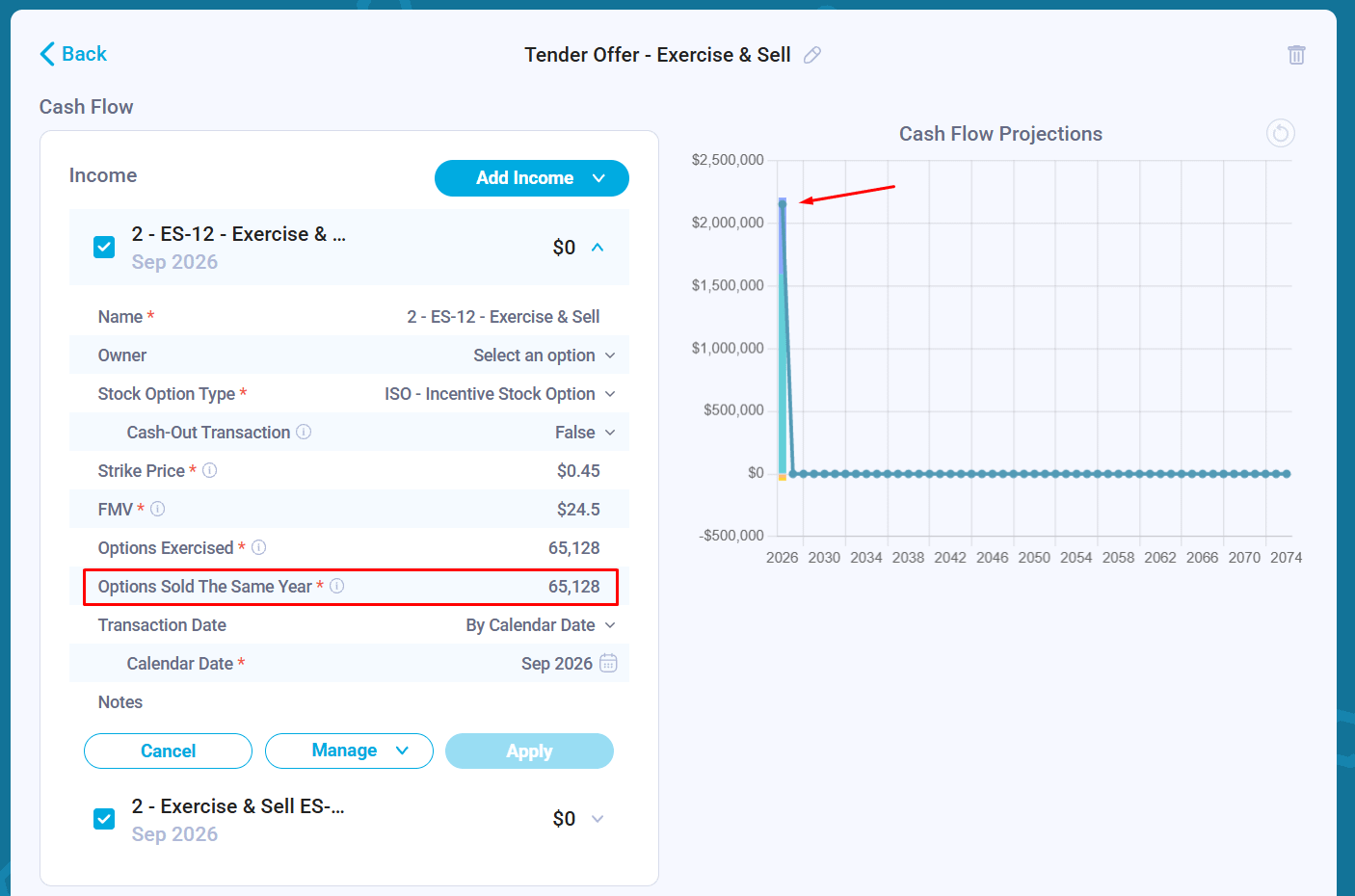
But the tax treatment changes significantly. Because the ISO shares are sold immediately after exercise, the transaction becomes a disqualifying disposition. In this simplified example, where the shares are sold at approximately the same price as their fair market value at exercise, the difference between the strike price and the share price is treated primarily as ordinary income.
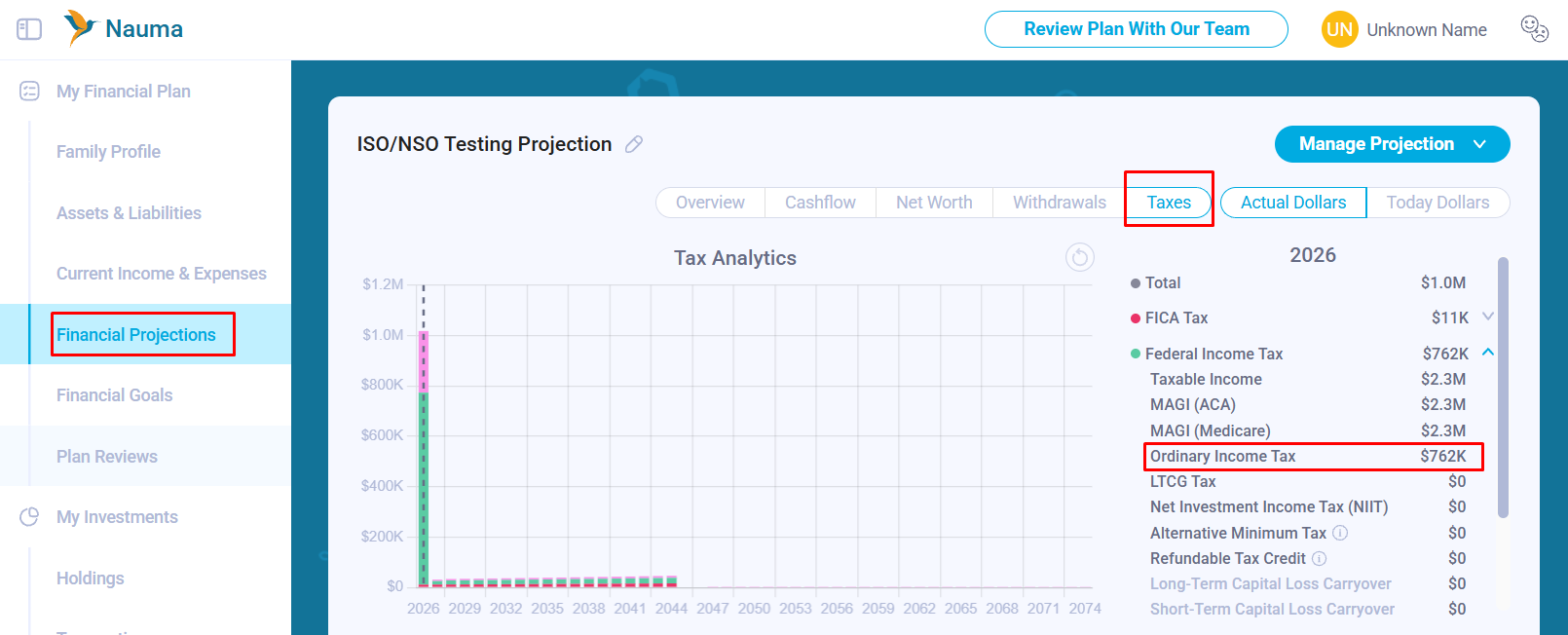
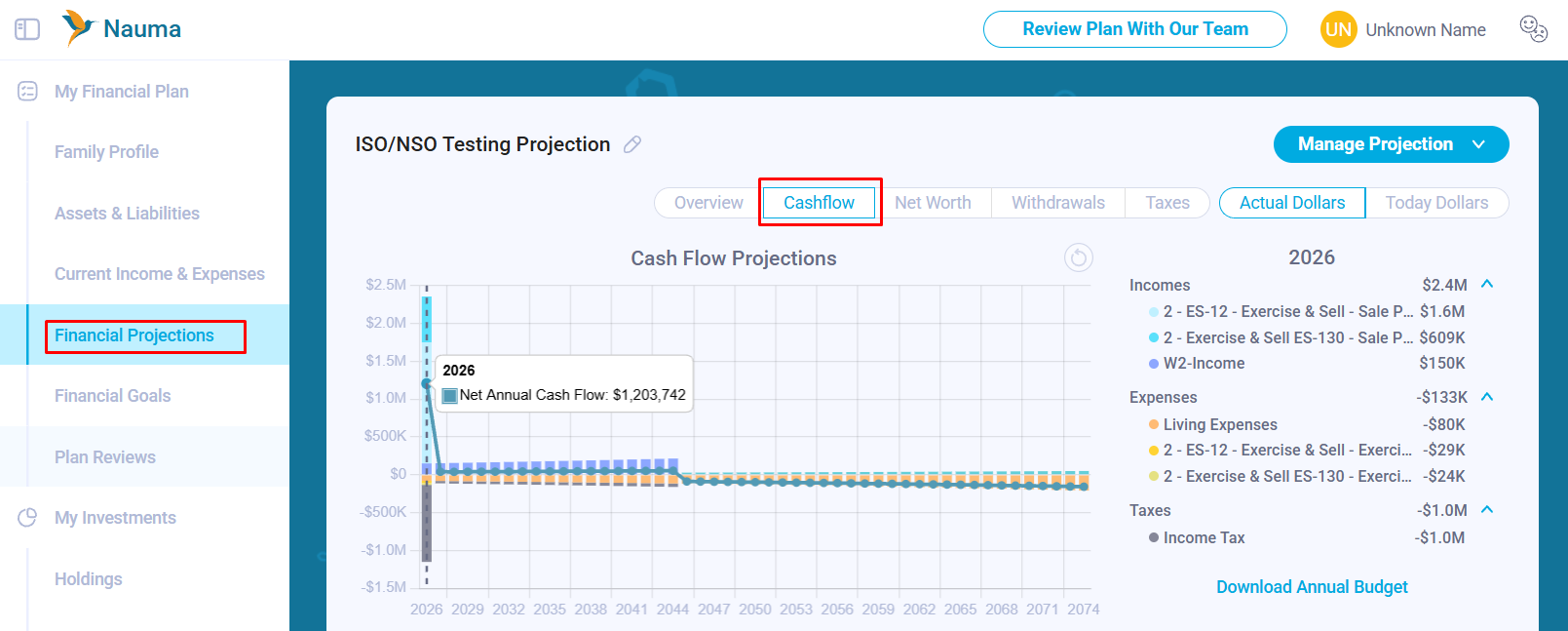
In the projection, the family pays approximately:
$762K in federal ordinary income tax
$245K in state ordinary income tax
The total estimated tax liability for the year is approximately $1M. Family Net Annual Cash Flow is $1.2M
Comparing Scenarios
At first glance, Option-1 looks like the obvious choice: the family already owns shares that qualify for long-term capital gains treatment, while exercising and immediately selling ISO shares creates ordinary income. Since long-term capital gains are generally taxed at lower federal rates than ordinary income, it is natural to assume that selling the existing shares should minimize taxes.
While Option-1 uses lower long-term capital gains rates, coupling the sale with an immediate exercise-and-hold of 90,000 ISOs creates a paper gain (ISO bargain element), triggering federal and California AMT.
Option 2 triggers higher ordinary income through a disqualifying disposition. However, because the ISO shares are exercised and sold in the same tax year, those shares do not generate the same ISO-related AMT adjustment.
It’s important to highlight that paying $670K in AMT does not necessarily create a permanent cost. The ISO exercise may generate a Minimum Tax Credit that can potentially offset regular tax in future years. The exercise also increases the shares’ AMT basis.
Evaluating the Long-Term Trade-offs
I modeled both strategies using the same hypothetical family and the same assumptions for income, spending, retirement, and investment growth.Under these assumptions:
Option 1: projected terminal net worth of approximately $2.6M
Option 2: projected terminal net worth of approximately $4.2M
That is a difference of $1.6M in projected terminal net worth. These numbers are not predictions of what will happen. They are hypothetical model outputs to illustrate how a change in today’s tax and cash-flow position can propagate through a long-term financial plan.
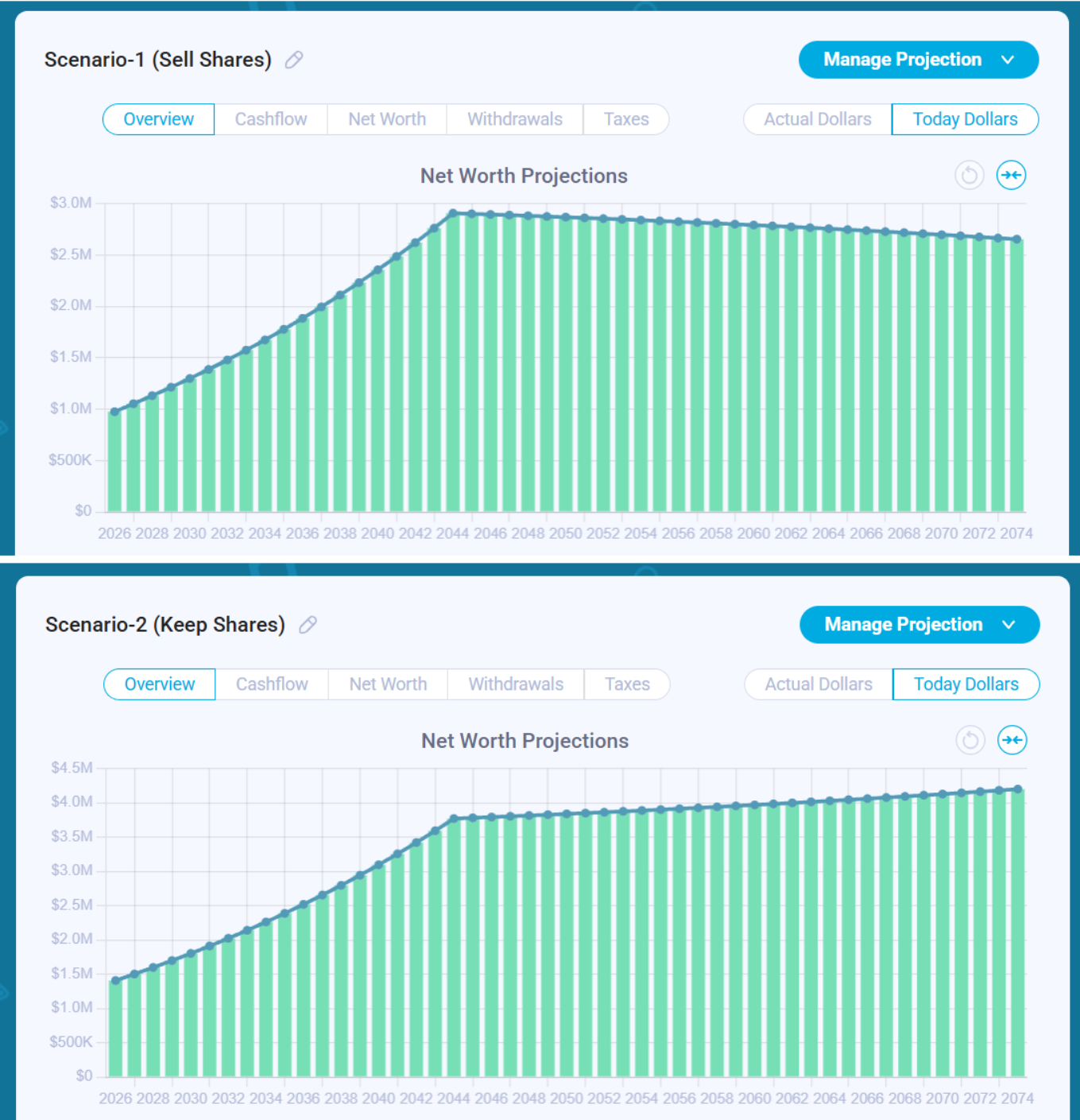
Illustrative Projection Model: This hypothetical example uses a deterministic financial projection with 6% annual pre-retirement investment growth, 4% annual post-retirement investment growth, and 2% inflation. 100,000 shares are then not used in net worth calculations. The results shown are hypothetical, are not actual results.
Selling long-term shares may look more tax-efficient in isolation, but once ISO exercises, AMT, state taxes, cash flow, and long-term compounding are taken into account, the result can change completely.
In this example, both strategies leave the family owning approximately the same number of company shares immediately after the tender offer, yet they produce approximately a $500K difference in estimated current-year taxes and, under the assumptions used in this projection, a $1.6M difference in projected terminal net worth.
A decision involving taxes and equity compensation today can materially affect the rest of a long-term financial plan. Financial projections make those interactions visible so the family can evaluate the trade-offs rather than relying on a single tax rate.
About The Author
Alex Sukhanov, founder of Nauma, a financial planning platform built for people in tech and high-net-worth families. Alex previously worked at Google and started Nauma to help more people in tech make better financial decisions and achieve more in their lives. You can reach out to Alex on linkedin.
Nauma is supported entirely by its users: no commissions, no affiliate incentives, and no financial products to sell. Built as an independent software platform rather than a traditional advisory firm, Nauma is designed to give tech professionals the tools and modeling clarity to evaluate their own equity, tax, and retirement scenarios.