“I’m retiring now and plan to sell my appreciated stock to cover my future expenses. The asset has a low cost basis. If I sell it today, it will trigger high capital gains taxes, which I want to avoid. I would like to use a CRUT to diversify in a tax-efficient way.”
This is a common scenario in conversations about retirement and tax planning. Taxes are high, especially in California, and it’s a real pain for many families to sell appreciated assets to get liquidity.
CRUTs show up in conversations with financial advisors when different strategies, including charitable giving, are discussed. In reality, a CRUT may not be the right strategy for these families, particularly when the primary motivation is reducing taxes rather than charitable giving.
There are four potential issues with the story above.
Mistake #1: Assuming charitable giving leaves you with more net worth than simple sale
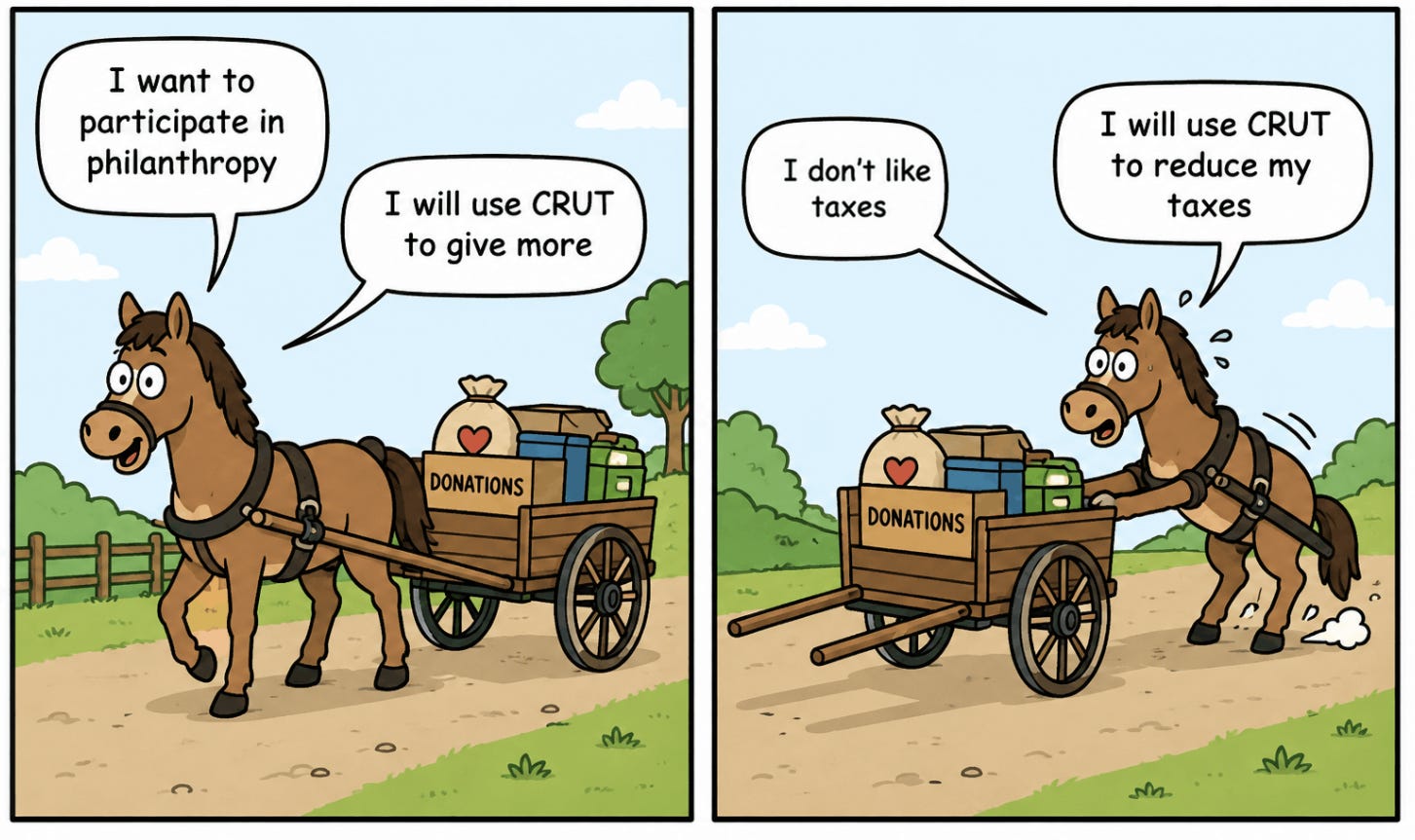
Charitable giving strategies, such as DAFs, QCDs, or CRUTs, are designed to allow donors to give more. This is different from the family ending up with a higher net worth.
The main benefit is letting the donor family avoid paying capital gains taxes when giving appreciated assets away and providing a charitable deduction that can be used to reduce their taxable income over the next five years. A CRUT additionally pays the beneficiary (the donor family) a fixed percentage of the trust’s value every year, but the amount is limited by strict IRS rules.
In many scenarios, the tax benefits and CRUT distributions do not fully compensate the donor family for the value ultimately committed to charity.
The family that is originally worried about taxes may have a more fundamental problem: they don’t know how much they need in the first place. Talking about charitable giving at this stage is a bit premature. The family needs to take a step back to create a financial plan and consider their net worth as a three-bucket system:
Money to maintain the family standard of living and enjoy life.
Money to leave to children, grandchildren, or other heirs.
Money to make an impact on the world through philanthropy.
Each family balances these buckets differently. It makes sense to discuss philanthropy and tax planning once these three buckets are defined in the financial plan and the family has a reasonable understanding of what they and their heirs need.
Mistake #2: Comparing the wrong numbers
Most CRUT calculators online are primarily designed to test compliance with IRC §664(d), including whether the charitable remainder requirements are satisfied and whether the payout rate falls within the 5%–50% range.
Some calculators go further and estimate the terminal value of the trust, often presenting the results as a “Sell vs. CRUT” comparison. Whether intentional or not, showing only these two scenarios can create the wrong impression. A user may conclude that using a CRUT will leave the family with a higher net worth than simply selling the asset.
In reality, the comparison often being shown is:
Donor Value + Trust Remainder > Simple Sale
But the trust remainder ultimately belongs to charity, not the donor family. If we exclude that charitable remainder and compare only the value retained by the donor family, the relationship is often:
Donor Value < Simple Sale
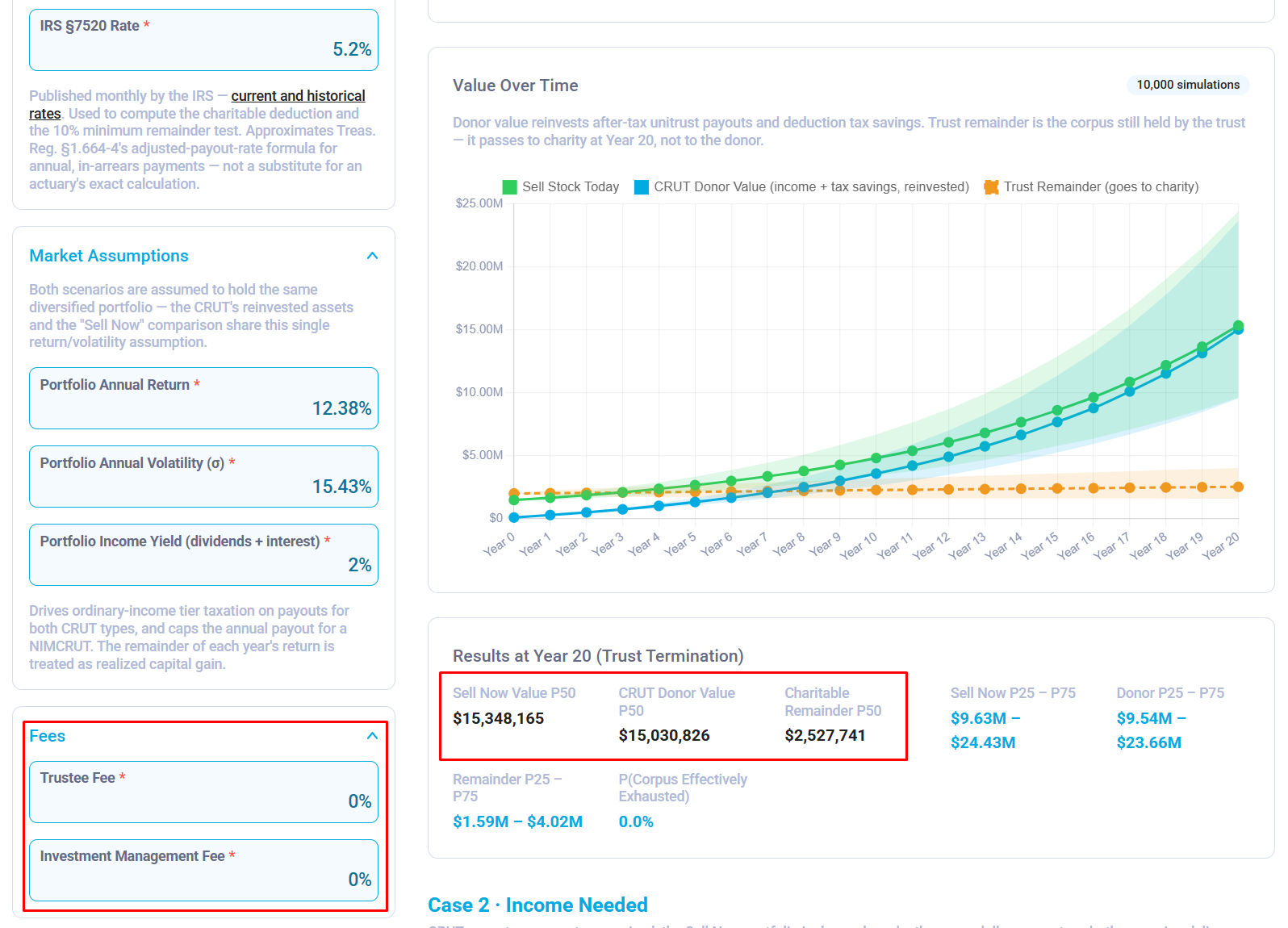
It’s important to confirm what exactly is being shown by a calculator. Here, the chart separates the results into three series, making the destination of the projected assets easier to see:
Simple Sale (green)
CRUT: Donor Value (blue)
CRUT: Trust Remainder (orange)
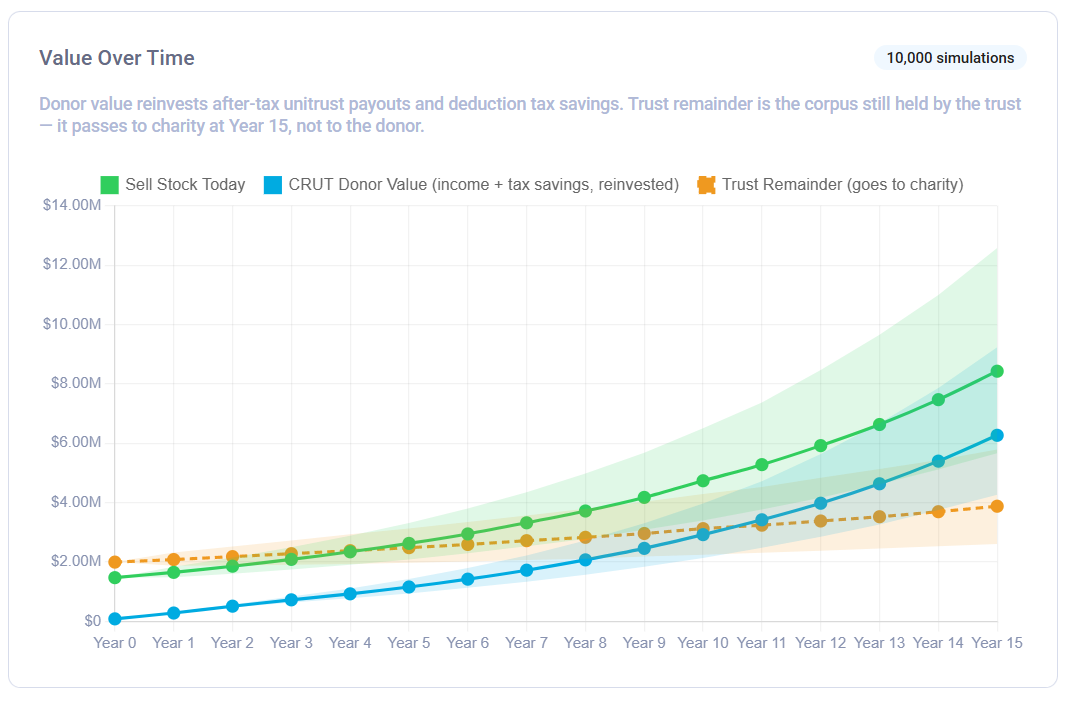
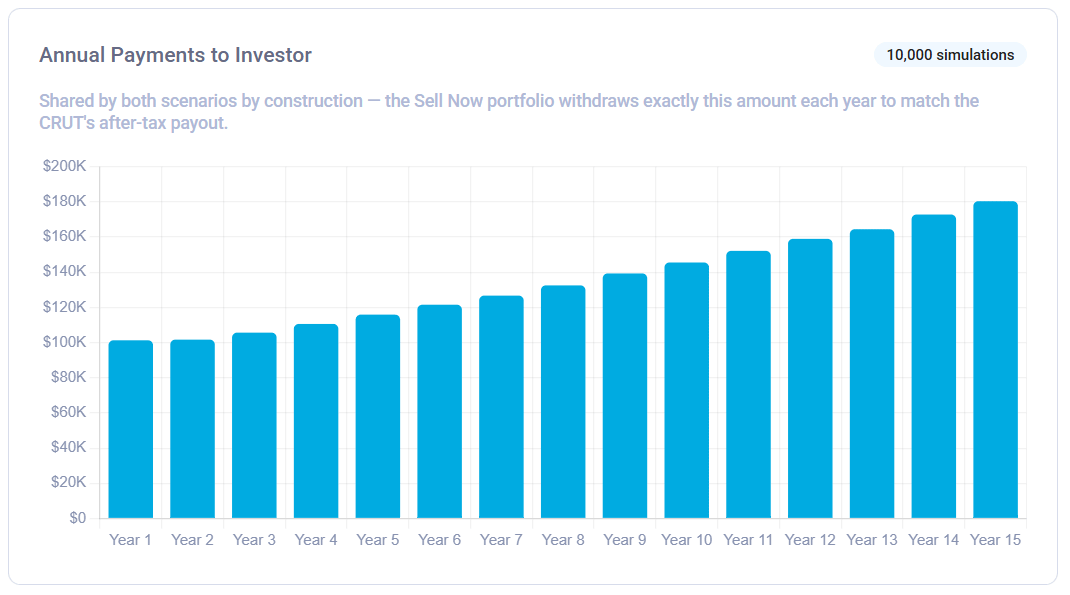
The next problem with calculators is that they often assume CRUT payouts are reinvested. In reality, many families consider using a CRUT to generate income in retirement and plan to spend the distributions.
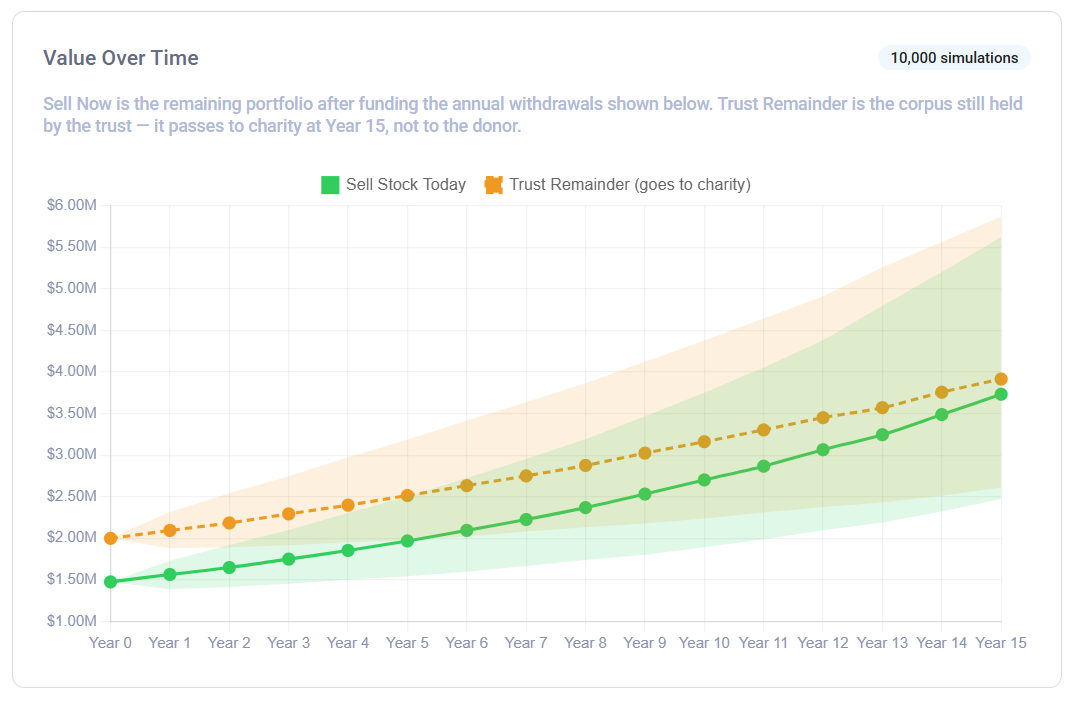
In this case, the model should actually compare the following scenarios:
I use a CRUT, receive a constant percentage payout, and the remainder goes to charity at the end.
I simply sell the assets, withdraw the same amount from my existing portfolio each year (and pay taxes), and then donate all the remaining money to charity.
If the family uses a CRUT, the charity often receives more, because capital gain taxes are not paid but being reinvested:
Mistake #3: Assuming you’ll use the full deduction
When the family contributes assets to a CRUT, they generate an upfront charitable income tax deduction in the year the trust is funded. The deduction value is equal to the present value of the remaining interest that will eventually pass to charity.
Retirees may expect the deduction to produce significant tax savings, but the actual benefit depends on whether and when the deduction can be used. In practice, families frequently fail to maximize this benefit due to 3 major constraints:
Retirement Income Drop: If a CRUT is created near retirement, lower future AGI may prevent the family from using the full deduction.
AGI Limits: Deductions for appreciated assets are generally limited to 30% of AGI for public charities and 20% for private foundations.
5-Year Carryforward: Unused deductions can be carried forward for up to 5 additional years.
To increase the likelihood that the deduction can be used before the carryforward expires, it should be incorporated into a multi-year tax plan. Strategies like executing Roth IRA conversions, recognizing deferred compensation, or timing other capital gains can increase your AGI, allowing you to absorb the full deduction while effectively filling up lower tax brackets.
Another option to maximize charitable deduction utility instead of increasing income in the next 5 years would be increasing Unitrust Payout Rate. That will automatically reduce the present value of the trust remainder and reduce charitable deduction.
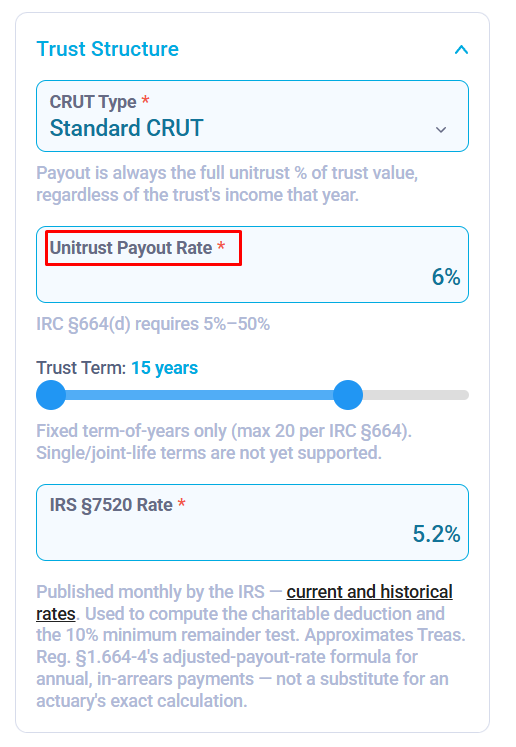
Without a proactive multi-year tax plan, the promised tax savings of a CRUT often end up larger on paper than in reality.
Mistake #4: Ignoring decades of fees
Establishing and maintaining a CRUT may involve legal, administrative, tax-preparation, trustee, and investment-management expenses. These costs should be included in any comparison because not every simplified calculator incorporates all of them.
When evaluating whether a CRUT actually leaves your family better off than a standard sale, these ongoing friction costs create a compounding drag on returns over time:
Upfront Setup Costs: Drafting a custom CRUT agreement, establishing trust tax IDs, and securing required independent appraisals (which are mandatory for non-publicly traded assets like real estate or private equity) typically run between $5,000 and $15,000+ in legal and accounting fees.
Annual Tax Compliance & Administration: CRUTs cannot file standard individual or grant-trust returns. They require specialized annual filings on IRS Form 5227 (Split-Interest Trust Information Return), Schedule K-1 distributions for beneficiaries, and complex 4-tier accounting rules. Professional tax preparation generally costs $1,500 to $4,000 every single year.
Investment & Corporate Trustee Fees: If you use an institutional trustee or hire a fiduciary to manage the trust’s portfolio, annual management fees typically range from 0.5% to 1.5% of the trust’s total asset value. Over a 20- to 30-year retirement, an extra 1% to 2% in annual administrative and management fees can materially reduce projected portfolio values. Because your annual unitrust payout is calculated as a fixed percentage of the trust’s value each year, these fees directly reduce the actual cash income distributed to your household.
Let’s consider a hypothetical scenario:
Concentrated Stock Value = $2M
Cost Basis = $300K
LTCG = 30.8% (Federal + NIIT + CA State)
CRUT: 20 years, payout rate 10%
Market returns: 12.38% return, 15.43% volatility (S&P 500 historical returns)
Without investment & corporate trustee fees, the terminal portfolio value P50 results:
Sell Now = $15.3M
CRUT (no fees) = $15M + $2.5M = $17.5M
CRUT (1% fees) = $14M + $2M = $16M
Conclusion
A CRUT is a powerful instrument for intentional philanthropy. It helps the family give more and provides some tax benefits, but it is not a tax-elimination loophole. If your primary objective is maximizing the net worth passed to your family, other strategies may be a better choice once you account for trust remainders going to charity, unabsorbed income tax deductions, and compounding administrative fees.
You can run your own scenarios and compare projected donor-retained value side-by-side using our Interactive CRUT vs. Simple Sale Calculator.
About The Author
Alex Sukhanov, founder of Nauma, a financial planning platform built for people in tech and high-net-worth families. Alex previously worked at Google and started Nauma to help more people in tech make better financial decisions and achieve more in their lives. You can reach out to Alex on linkedin.
Nauma is supported entirely by its users: no commissions, no affiliate incentives, and no financial products to sell. Built as an independent software platform rather than a traditional advisory firm, Nauma is designed to give tech professionals the tools and modeling clarity to evaluate their own equity, tax, and retirement scenarios.